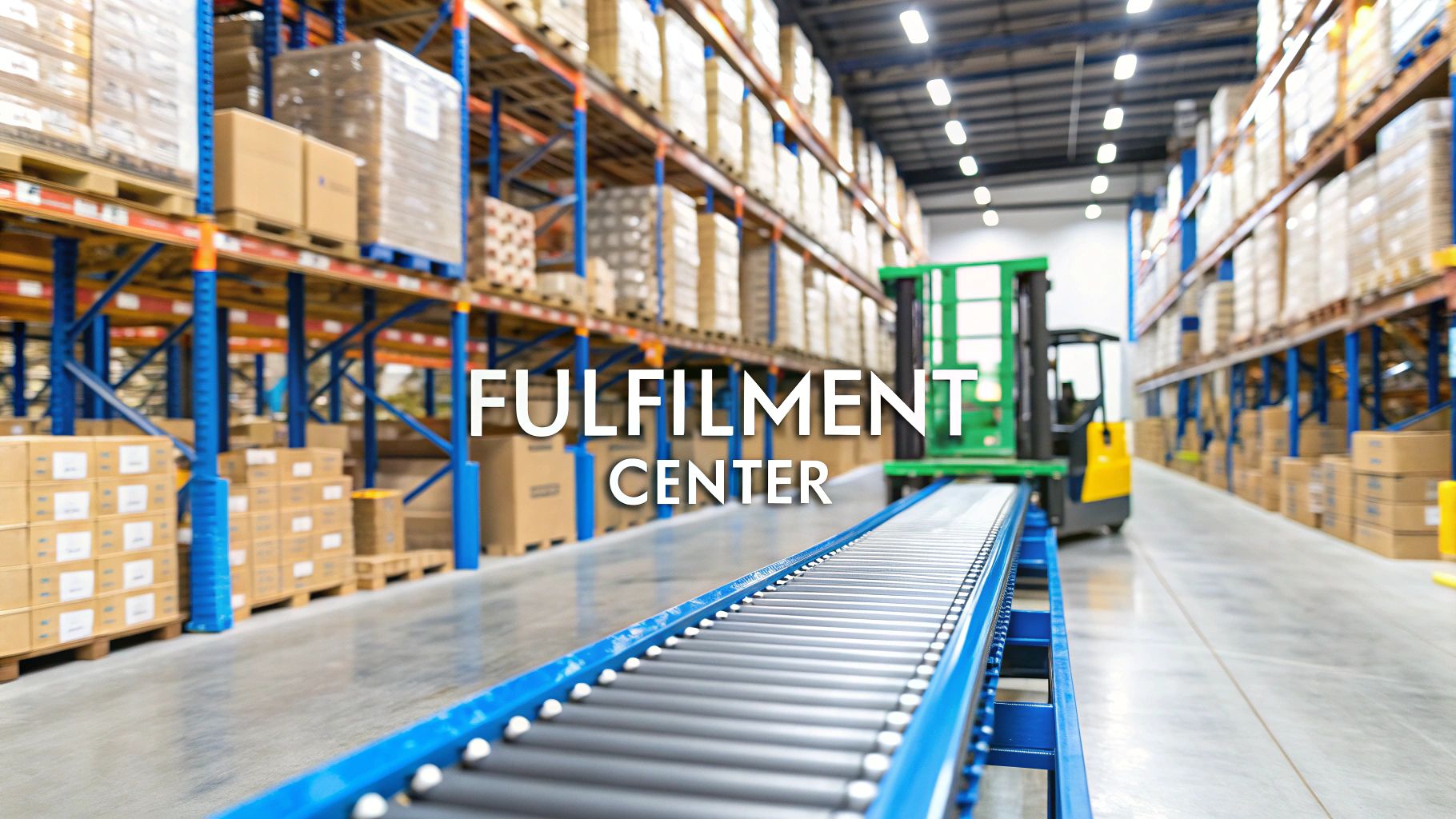
Think of a fulfillment center as the operational heart of your e-commerce brand. It’s the behind-the-scenes powerhouse that takes over the moment a customer clicks “buy,” handling everything required to get your products from a shelf into their hands.
Instead of your garage or back room being buried in boxes, a fulfillment partner receives your inventory, stores it securely, and then picks, packs, and ships each order out. It’s the engine that powers your entire post-purchase customer experience.
The Core Function of a Fulfillment Center
A fulfillment center is mission control for your brand's logistics. Its entire reason for being is to process direct-to-consumer (DTC ) orders with precision and speed. This isn't just a big building for storage; it's a dynamic, high-activity environment designed for the constant flow of products moving in and out.
When you partner with one, you’re effectively handing over the entire physical side of your business. That means no more printing labels, wrestling with packing tape, or making endless trips to the post office. You get to focus on the things that actually grow your brand—marketing, creating new products, and connecting with your customers.
More Than Just Storage It's a common mistake to think fulfillment centers are just big sheds for inventory. While storage is part of the equation, their real value comes from the active services they provide. The entire facility, from its physical layout to its inventory management software, is built to get products out the door, not just sit on them.
This focus on outbound movement is what separates a fulfillment center from other facilities in the supply chain. If you want to get into the weeds, you can explore the key differences between a fulfillment center and a distribution center in our detailed guide.
To bring this all together, here is a quick look at the fundamental differences between a fulfillment center and a more traditional warehouse.
Fulfillment Center vs. Traditional Warehouse at a Glance Feature Fulfillment Center Traditional Warehouse Primary Goal Ship orders to end customers (DTC ) quickly Store products for long periods (B2B ) Activity Level High-volume, constant activity Low-volume, infrequent activity Inventory Turnover Fast (days or weeks) Slow (months or years) Customer Focus Direct-to-Consumer (B2C ) Business-to-Business (B2B ) Core Operations Picking, packing, shipping individual orders Receiving & storing pallets, bulk shipping Key Metric Order accuracy and speed Storage capacity and efficiency
As the table shows, one is built for motion and the other for stillness. This distinction is crucial for any growing e-commerce brand.
The core operations inside a fulfillment center are all about action:
Receiving Inventory: Your incoming products are inspected, counted, and logged into a central management system.Secure Storage: Your items are organized in dedicated, tracked locations (bins, shelves, or pallets) for quick and easy access.Order Processing: As soon as an order comes in, a team member picks the correct items from their storage locations.Packing and Shipping: Items are professionally packed, a shipping label is generated, and the package is handed off to a carrier like USPS, FedEx, or UPS.A fulfillment center’s success isn't measured by how much it can hold, but by how quickly and accurately it can process and ship an order. Its value is in motion, not static storage.
Ultimately, the goal is to create a seamless link between your online storefront and your customer's doorstep. A fulfillment partner takes over the complex, time-consuming tasks of order management, empowering you to scale without getting bogged down. It becomes an extension of your team, dedicated to delivering a professional and reliable experience that feels like it came directly from you.
The Journey from Storage Shed to E-commerce Powerhouse The modern fulfillment center didn’t just appear out of nowhere. Its story begins in the dusty, slow-moving warehouses of the 20th century—massive buildings designed for a completely different world. Think pallets stacked to the ceiling, all holding the same product, destined for a handful of big-box retail stores.
Their job was simple: store huge quantities of goods for long stretches and ship them out infrequently in massive truckloads. The entire operation was predictable, straightforward, and built for a business-to-business (B2B) model. The end customer was a distant thought, several steps removed from the warehouse's day-to-day reality.
The E-commerce Explosion Changes Everything Then came online shopping, and the old model shattered. The explosion of e-commerce created a tidal wave of demand that traditional warehouses were completely unprepared to handle. Suddenly, the game wasn't about shipping a hundred pallets to ten retailers; it was about shipping one unique item to a hundred thousand individual customers.
This radical pivot from bulk B2B shipments to high-volume, small-parcel, direct-to-consumer (DTC) orders demanded a total reinvention. The quiet, static warehouse had to transform into a dynamic, high-velocity hub of constant activity. This was the true birth of the modern fulfillment center.
A fulfillment center is the direct descendant of the traditional warehouse, but it was forced to evolve by a simple yet powerful force: a customer clicking "buy now" from their living room.
This evolution was fueled by mind-boggling growth. The global e-commerce fulfillment market was valued at USD 123.7 billion and is on track to more than double to roughly USD 272 billion by 2030 . This boom also triggered a huge shift in how brands manage their inventory, with around 60% of online retailers now outsourcing at least some of their fulfillment. You can dive deeper into the rise of fulfillment companies on cs-cart.com .
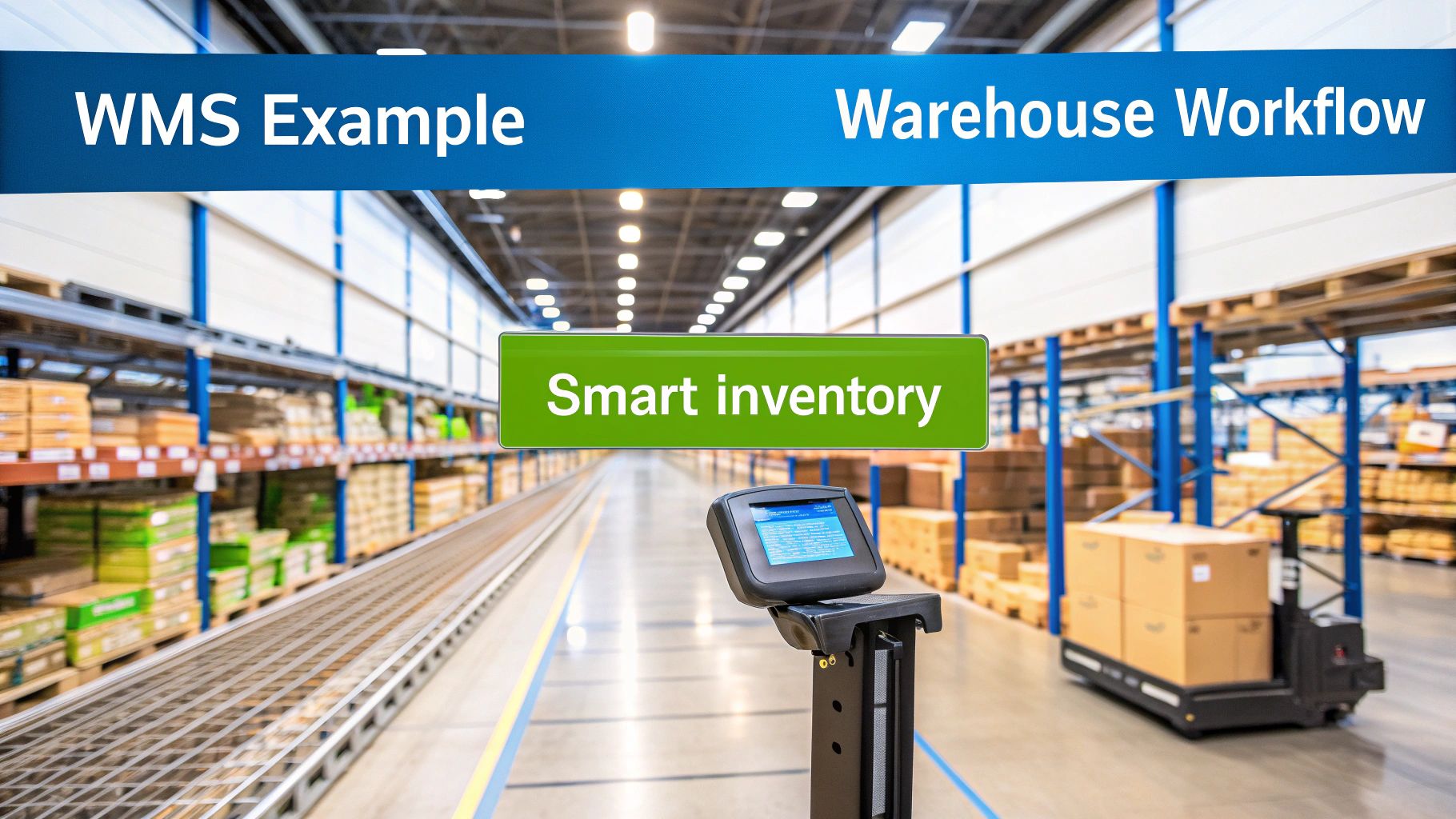
Technology Becomes the Backbone To keep up with this new reality, fulfillment centers embraced technology. Advanced Warehouse Management Systems (WMS) became the brain of the operation, giving teams real-time visibility into every single piece of inventory. A good WMS directs staff on the most efficient picking paths, ensuring orders are accurate and out the door fast.
At the same time, automation became essential. Robotics and complex conveyor systems were brought in to accelerate processes that were once done entirely by hand. These technologies weren't just about replacing people; they were about working alongside them to meet an unprecedented scale of demand.
Robotics: Autonomous mobile robots (AMRs) now zip around the floor, bringing shelves directly to pickers and cutting down on endless walking.Automated Sorting: High-speed sorters can process thousands of packages an hour, routing them to the correct outbound trucks with incredible precision.Advanced Scanners: Wearable and ring scanners allow for hands-free work, boosting both picking speed and accuracy.This tech adoption was kicked into high gear by another powerful force: customer expectations. The promise of two-day—and now even same-day—delivery became the new normal. This expectation turned the fulfillment center from a behind-the-scenes cost center into a critical piece of the customer experience and the true engine of online retail.
A Day in the Life of Your Product at a Fulfillment Center To really get what a fulfillment center is all about, let's ditch the formal definitions. Instead, let's follow the journey of one of your products. Imagine you sell handcrafted leather wallets and just shipped a fresh batch to your fulfillment partner. Here’s a play-by-play of what happens next, turning abstract logistics into something you can actually picture.
The whole thing is a tightly choreographed dance. Every move is tracked, optimized, and carried out with precision to make sure the right product gets to the right person, on time.
Step 1: Receiving and Inbound Processing The journey kicks off the second your shipment of wallets hits the fulfillment center's receiving dock. This isn't just a simple drop-off; it's a critical first step. The team carefully unloads your boxes, checking the count against the shipping manifest you sent over to make sure everything adds up.
Next, each wallet gets a quick inspection for any damage. Once they pass muster, every single item is scanned and logged into the Warehouse Management System (WMS) . This digital check-in is the key—it instantly updates your inventory levels, giving you a real-time view from your own computer. Your wallets are no longer just "in transit"; they're now officially active inventory, ready to be sold.
Step 2: Strategic and Secure Storage After your wallets are checked in, they aren't just tossed onto a random shelf. The WMS gives them a specific, strategic home—maybe a small bin, a dedicated shelf space, or a pallet, all depending on your product's size and how many you sent.
This is worlds away from finding a spot in your garage. Every single location is barcoded and tracked. The system knows the exact row, shelf, and bin where your wallets are sitting, creating a hyper-organized environment that's the secret sauce for fast, accurate order picking later on.
This infographic shows just how far this process has come from the old-school warehouse model.
You can see the clear shift from just stacking pallets to the tech-driven, direct-to-consumer model that defines a modern fulfillment center.
Step 3: Order Picking with Precision Now for the magic. A customer places an order on your website. In a flash, your e-commerce platform shoots the order details straight to the fulfillment center's WMS. Instantly, a "picking ticket" is created and sent to a warehouse associate.
The WMS doesn't just list the item; it maps out the most efficient route for the picker to get to your wallet's exact location, cutting down on wasted time. Once they arrive, they scan the product's barcode to confirm it’s the right item before placing it in a tote. This simple scan-to-verify step is what crushes human error, allowing top-tier centers to hit accuracy rates over 99.9% .
The picking process is a perfect blend of human effort and system-driven intelligence. The goal is simple: find the right product as quickly and accurately as possible.
Step 4: Professional Packing and Branding Once picked, your wallet makes its way to a packing station. Here, another team member gives it one last look-over. Following your specific instructions, they'll package it up securely for its journey to the customer.
This is also where your brand's personality can shine. The packer might use your custom-branded boxes, slip in a thank-you note, or add any promotional inserts you've provided. They’ll then print a packing slip, pop it in the box, and seal it up tight.
Step 5: Shipping and Carrier Hand-Off At the final stop, the sealed package is weighed and measured. The system automatically crunches the numbers and selects the best shipping carrier—like FedEx, UPS, or USPS—based on rules you've set for cost and delivery speed. A shipping label is printed and slapped on, and the package joins other outbound shipments.
Throughout the day, carriers arrive to pick up these sorted packages. The moment your wallet is on that truck, its tracking number goes live, and an automated shipping confirmation zips out to your customer.
Step 6: Handling Returns Management The journey doesn't always end when the package is delivered. If a customer decides to return the wallet, the process simply works in reverse. The fulfillment center receives the return, inspects it to see if it's in good shape, and handles it according to your rules. It might be restocked for resale, set aside for refurbishment, or disposed of—and your inventory levels are updated every step of the way.
To get a closer look at these operational steps, you can dive deeper into how e-commerce fulfillment works in our comprehensive guide.
Services That Go Way Beyond the Brown Box
A modern fulfillment center is so much more than just a place to store and ship products. While the core job will always be picking and packing, the best partners have evolved into strategic extensions of your brand. They offer a whole suite of services designed to create amazing customer experiences, make your operations smoother, and even help you find new ways to sell.
Think of it this way: basic fulfillment gets a product from Point A to Point B. The services we're about to cover? They make that entire journey feel like a deliberate, memorable, and high-touch brand moment.
Kitting and Bundling Services One of the most powerful tools in a fulfillment center’s arsenal is kitting and bundling . This is simply the process of taking several different products (each with its own SKU) and assembling them into a single, ready-to-ship package. It's the magic behind subscription boxes, holiday gift sets, and "buy two, get one" promotions.
A fulfillment partner does all this assembly work for you, creating a brand new "kit" SKU that's ready to go the moment an order drops.
Example in Action: Imagine a monthly coffee subscription. You send your fulfillment partner bags of coffee, branded mugs, and sample packs of biscotti. The fulfillment team assembles one of each into a custom box, creating a "Coffee Lover's Kit." This kit is then stored as one new item, ready to ship instantly.This service frees you up to get creative with your marketing and sales efforts, without bogging down your own team with complex assembly tasks.
Custom Packaging and the Unboxing Experience In the world of DTC, the first physical interaction a customer has with your brand is the package that lands on their doorstep. A thoughtfully designed unboxing experience can create an instant emotional connection, boost loyalty, and get people sharing your product on social media.
The unboxing experience is your brand’s physical handshake with the customer. It transforms a simple delivery into a memorable event, turning a one-time buyer into a loyal advocate.
This is about more than just a box. A top-tier fulfillment center can help you craft this moment with a range of options:
Branded Boxes: Your logo, your colors, your style—right on the box.Custom Inserts: Thank-you notes, special offers, or how-to guides.Specialty Tissue Paper: Wrapping items in branded or colored tissue for that premium feel.Eco-Friendly Materials: Showing you care with recyclable fillers or compostable mailers.A boutique clothing brand, for instance, might have its fulfillment partner wrap each garment in branded tissue paper, include a high-quality thank-you card, and ship it all in a custom-printed mailer bag. Every detail reinforces the brand's premium identity.
Advanced Inventory Management A great fulfillment partner doesn't just store your stuff; they give you the data and tools you need to manage it like a pro. This is about more than just knowing what's on the shelf. It's about having real-time information to make smarter purchasing and marketing decisions. This kind of insight is absolutely crucial for mastering Amazon inventory management and dodging the painful costs of stockouts or dead stock.
Your fulfillment partner's technology should give you:
Real-Time Visibility: A dashboard showing you exactly what you have, right now.Low-Stock Alerts: Automated emails when an item hits a reorder threshold you've set.Lot Tracking: The ability to track specific production batches—a must-have for anything with an expiration date, like cosmetics, supplements, or food items.This isn't just data for data's sake. This is the control you need to run an efficient supply chain, prevent lost sales, and keep your cash from being tied up in products that aren't moving.
Returns Management (Reverse Logistics) Finally, let's talk about the one part of e-commerce nobody loves: returns. A true fulfillment partner takes this off your plate with a process called reverse logistics . When a customer sends something back, the center receives it, inspects it based on your specific rules, and puts it where it needs to go.
An item might be restocked if it's in perfect condition, set aside for refurbishment, or disposed of. A smooth, painless returns process is a huge part of the customer experience, turning what could be a negative interaction into a moment that builds trust.
And if you want to understand the foundational steps that come before these more advanced services, be sure to check out our guide to pick and pack fulfillment for e-commerce .
How a Fulfillment Partner Unlocks Business Growth Understanding what a fulfillment center does is one thing; seeing it as the growth engine for your brand is something else entirely. Working with a logistics expert isn't just another operational cost—it's a strategic investment that pays off in savings, scalability, and customer loyalty.
It’s the move that finally gets you out of the weeds of running your business so you can start working on your business again.
Think about the classic founder story: a garage overflowing with inventory, evenings lost to a mountain of packing tape and boxes, and every big sales day bringing a mix of excitement and pure dread. That operational bottleneck is actively holding back growth.
Now, picture the "after." Orders flow seamlessly from your online store to a professional facility, freeing you up to focus on what really matters—marketing, product development, and building relationships with your customers. That's the fundamental shift a fulfillment partner delivers.
Achieve Immediate Cost Savings and Efficiency Outsourcing your fulfillment instantly turns many of your fixed costs into variable ones. Instead of being locked into a warehouse lease, staff salaries, and pricey equipment, you pay only for what you use. For a growing brand, this model is simply a smarter way to manage capital.
You also tap into bulk shipping discounts that are completely out of reach for smaller businesses. Fulfillment centers ship thousands of packages every single day, letting them negotiate much lower rates with carriers like FedEx and UPS. Those savings get passed directly on to you.
Scale Your Operations on Demand One of the biggest wins is the ability to scale in a heartbeat. When Black Friday hits or a marketing campaign goes viral, a fulfillment partner has the staff, space, and technology to handle a massive spike in orders without breaking a sweat. Your business can grow without the growing pains.
A fulfillment partner acts as an operational shock absorber. They are built to handle the extreme peaks and valleys of e-commerce demand, ensuring your customer experience remains consistent whether you have ten orders or ten thousand.
This kind of operational reliability isn't just a feeling; it's backed by hard data. For instance, top-tier fulfillment providers can hit order accuracy rates as high as 99.95% . The financial impact is huge, with one report showing a single merchant saving $1.5 million by using a fulfillment network.
When you consider that the largest online retailers spend nearly $100 billion on fulfillment each year, you realize that optimizing this part of your business is one of the smartest financial moves you can make.
Enhance Customer Satisfaction and Loyalty At the end of the day, growth comes from happy, repeat customers. Faster, more accurate shipping is a direct line to customer satisfaction. When an order arrives on time and in perfect condition, it builds trust and makes your brand look good. A great fulfillment partner ensures this final, crucial touchpoint is flawless every time.
While a fulfillment partner handles the logistics of getting products to your customers, you still need to get those sales in the first place. Learn how to optimize e-commerce conversion rates to keep your fulfillment center busy. By handing off the logistics, you gain the freedom to focus on every other part of your brand that truly drives growth.
Selecting the Right Fulfillment Partner for Your Brand Choosing a fulfillment partner is easily one of the biggest decisions you'll make for your e-commerce brand. This isn't just about renting some shelf space; you're handing over your entire customer experience to another company. Get it right, and your partner becomes a seamless extension of your team. Get it wrong, and you're looking at a nightmare of shipping delays, angry customers, and a tarnished reputation.
Making the right call means looking past the sales pitches and doing a clear-eyed evaluation of what really matters. Think of it like hiring a key employee—you need to vet their skills, check their reliability, and make sure they're a good fit for where you want to go.
Start with Technology and Integrations Before you even think about warehouse locations, look at the software. A fulfillment center's technology is its central nervous system. If it can't talk to your e-commerce platform flawlessly, nothing else matters. You need an integration that's deep, dependable, and fully automated.
Look for a partner with pre-built, one-click integrations for major platforms like Shopify , BigCommerce , or Amazon . This is non-negotiable. It ensures that orders, inventory levels, and tracking information flow between your systems in real-time, no manual entry required. A clunky or unreliable connection is a massive red flag that will create one operational headache after another.
A fulfillment center’s value is directly tied to the quality of its technology. If their system can’t speak the same language as your online store, you're setting yourself up for constant communication breakdowns, from stockouts to shipping errors.
Analyze Their Physical Network and Location Where a fulfillment center is located directly impacts your two most important post-purchase metrics: how fast your packages arrive and how much it costs to ship them. A single warehouse in one corner of the country might work when you're just starting out, but as you grow, you need a partner with a strategic distribution network.
Placing your inventory in multiple fulfillment centers closer to your customers is a total game-changer. This multi-node approach lets you offer affordable two-day shipping to a huge portion of the country. A partner with locations on both coasts or in key central hubs can slash transit times and costs, which is a massive competitive advantage. According to recent reports, 73% of shoppers expect affordable, fast shipping, making location a make-or-break factor.
Vet Their Specialization and Experience Not all fulfillment centers are created equal. Some are great with apparel, others are experts in fragile electronics, and a select few have the certifications to manage hazardous materials or perishable goods. It’s absolutely critical to find a partner with proven experience in your specific product category.
Don't be afraid to ask them directly about their experience with products like yours.
Apparel: Do they have established processes for poly-bagging, handling returns, and managing endless SKU variations for size and color?Electronics: Are their facilities secure? Are they set up to handle fragile, high-value items without damage?Subscription Boxes: Can they handle complex kitting, custom packaging requests, and recurring order schedules without breaking a sweat?Supplements: Are they certified for products with expiration dates and lot tracking requirements?For a deeper dive, our guide on evaluating fulfillment partners for your e-commerce business
Common Questions About Fulfillment Centers Jumping into the world of third-party logistics can feel like you're learning a new language. To help you cut through the jargon, here are some clear, straightforward answers to the questions we hear most from e-commerce founders.
What Is the Difference Between a Fulfillment Center and a 3PL? It's easy to see why these terms get mixed up, but the distinction is pretty simple. Think of a Third-Party Logistics (3PL) provider as the umbrella company you hire. They offer a whole suite of supply chain services, from freight forwarding to strategic consulting.
A fulfillment center is the actual, physical building where the magic happens for your e-commerce orders. It's a specific type of facility—often owned and operated by a 3PL—that is purpose-built for picking products off shelves, packing them into boxes, and shipping them directly to your customers.
So, when you sign on with a 3PL, they're the partner managing the big picture. Their network of fulfillment centers is the tool they use to get your orders out the door.
How Much Does a Fulfillment Center Cost? There’s no single price tag, because costs are broken down into a few key areas. Getting a handle on these components is the secret to comparing quotes and avoiding any nasty surprises on your monthly invoice.
Your final fulfillment bill is always a mix of fees for services performed and the space your inventory takes up. Make sure you get a detailed quote that breaks down every single charge so you can actually forecast your expenses.
Here are the typical charges you'll run into:
Initial Setup Fee: A one-time cost to get your brand integrated into their system.Receiving Fees: This covers the labor for unloading your inventory, inspecting it, and getting it put away on the shelves.Storage Fees: A recurring monthly cost based on how much space your products occupy. This is usually calculated per pallet, shelf, or bin.Pick and Pack Fees: You’ll see this on every order. It’s a fee for the labor involved in pulling products and boxing them up for shipment.Shipping Costs: This is the actual postage paid to carriers like FedEx, UPS, or USPS. The good news? It's almost always at a heavily discounted rate.When Is the Right Time to Outsource Fulfillment? Forget about hitting a specific order number. The real tipping point is when managing logistics yourself starts getting in the way of growing your business. It's less about a number and more about feeling the operational strain.
You'll know it's time to make the switch when:
You spend more of your day taping up boxes than you do on marketing or product development. Your garage, office, or spare bedroom is completely overflowing with inventory. You can't keep up with your shipping promises, especially during a big sale. Customer emails about shipping errors or delays are starting to pile up. As a general rule of thumb, once you're consistently shipping over 100 orders per month , the time saved and efficiencies gained from partnering with a fulfillment center become incredibly hard to ignore.
Ready to stop packing boxes and start scaling your brand? Simpl Fulfillment offers transparent pricing, seamless integrations, and a dedicated team to handle your logistics with the care your brand deserves. Get a free quote today and see how we can help you grow .