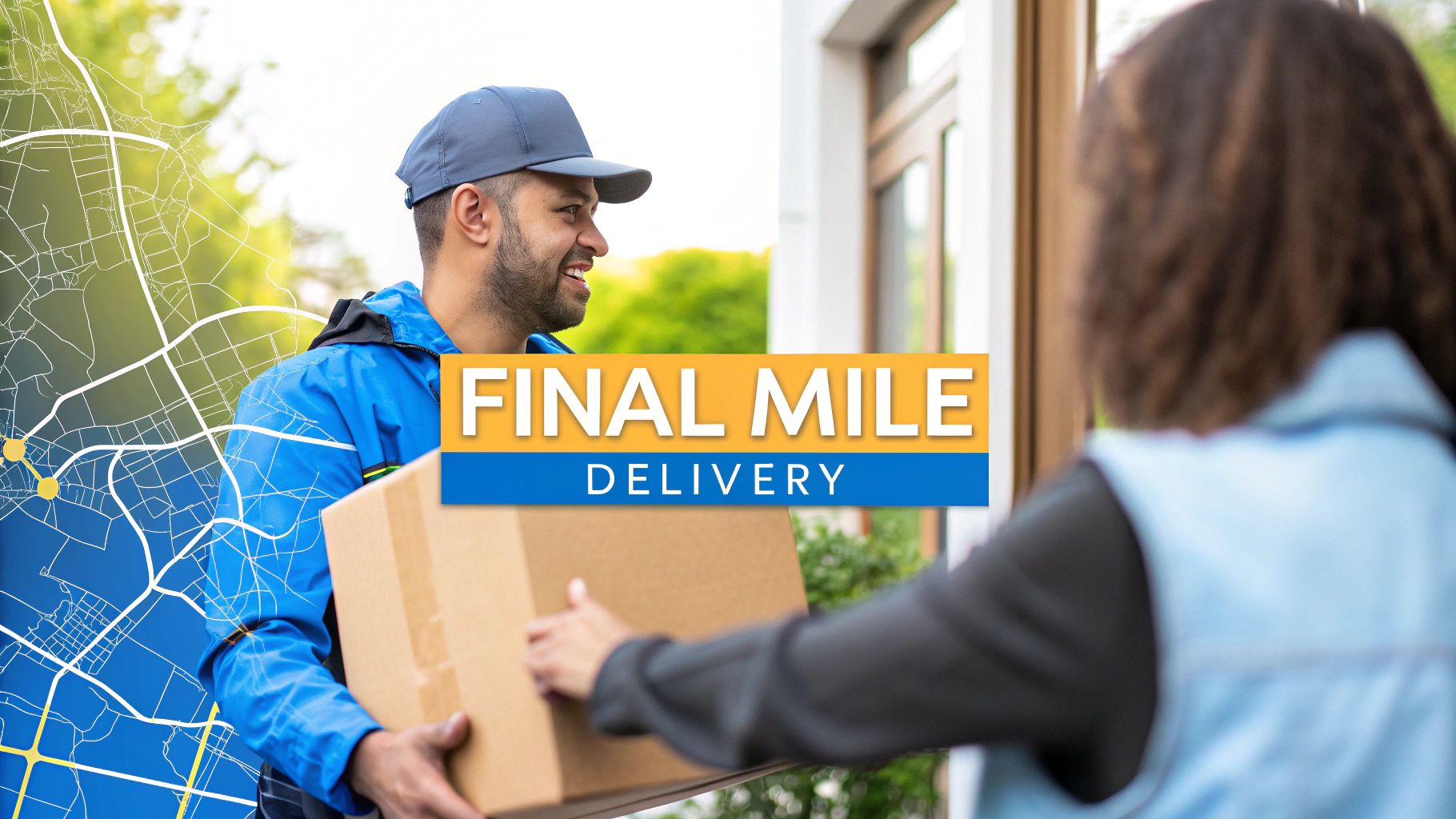
Final mile delivery is the very last step in a long shipping journey—the moment a package leaves a local warehouse and makes its way to your customer's front door. Think of it as the final lap in a relay race. It might be the shortest distance, but it’s where the entire race is won or lost. This single stage carries almost all the weight when it comes to customer satisfaction and how people feel about your brand.
Why the Last Mile Is the Most Important Mile
From the factory floor to the regional warehouse, your entire supply chain is a massive, complex machine humming away behind the scenes. Your customers don’t see any of that. The final mile, however, is the one part they do see, touch, and experience firsthand. It’s the moment your online brand becomes a real, physical thing in their hands.
This single touchpoint can either powerfully reinforce all the promises you've made in your marketing or completely shatter them.
A great final mile delivery isn't just about dropping a box on a porch. It’s about delivering an experience that feels reliable, professional, and even personal. When a package shows up on time, in perfect shape, and with clear updates along the way, it builds a tremendous amount of trust. On the flip side, a single delay, a crushed box, or a lost package can wipe out all the goodwill you've built, no matter how incredible your product is.
The Human Element of Logistics Before a package hits the final mile, its journey is mostly industrial and automated. It travels on pallets between huge distribution centers, handled by forklifts and sorted by massive systems.
The final mile is completely different. It's deeply human. It comes down to a delivery driver navigating local traffic, finding the right house, and interacting—even if just for a moment—with your customer.
This is what makes the final stage so unique:
Customer Perception: This is often the only face-to-face interaction in the entire e-commerce journey, making it a powerful branding moment.Emotional Impact: The anticipation of getting an order is a real feeling. A smooth delivery creates delight, while a bad one leads straight to frustration and scathing online reviews.Brand Accountability: Your customers don’t care if it was a third-party courier's fault. To them, a late delivery is your fault.The final mile is where the logistical rubber meets the road of customer experience. It transforms a faceless online transaction into a tangible, memorable interaction that can determine whether a first-time buyer becomes a lifelong advocate.
The table below breaks down the key steps involved in this critical process, showing how each one directly influences what your customer experiences.
Stage Description Impact on Customer Experience Order Processing The order is received at the local distribution center and assigned to a specific delivery route. Accuracy here prevents shipping to the wrong address, a major source of frustration. Dispatch & Routing Packages are loaded onto the delivery vehicle, and the driver's route is finalized. Efficient routing ensures on-time delivery and minimizes delays from traffic or other issues. In-Transit Updates The package is scanned at various points, triggering tracking notifications for the customer. Real-time visibility reduces anxiety and gives the customer a sense of control. Final Delivery The driver arrives at the customer's address and completes the delivery. A professional, on-time drop-off is the final, lasting impression of your brand. Proof of Delivery A photo is taken or a signature is collected to confirm the package has been delivered safely. This provides peace of mind and helps resolve any "where is my package?" inquiries quickly.
Each of these stages is a chance to either impress your customer or let them down, making a well-managed final mile operation absolutely essential.
Market Growth and Customer Expectations The pressure to perfect this process is only growing. The global last-mile delivery market is on track to expand by an incredible USD 51.1 billion between 2025 and 2029, all thanks to the unstoppable rise of e-commerce.
As more people shop online, their expectations for speed, transparency, and convenience are skyrocketing, putting immense pressure on brands to get it right. You can dive deeper into these market forces and find additional insights on last-mile delivery trends in our related article . This explosive growth is precisely why optimizing your final mile delivery isn't just a good idea anymore—it's a requirement for survival.
The True Cost of Getting a Package to the Doorstep Ever wondered why that last little hop from a local warehouse to a customer’s front door costs so much? It’s a classic logistics puzzle. While long-haul shipping is all about efficiency and economies of scale—cramming thousands of boxes onto a single truck—the final mile is the exact opposite. It's a complex, one-to-one delivery that’s notoriously expensive.
Just how expensive? Shockingly, this last leg can eat up more than 50% of your total shipping budget . For many e-commerce brands, this is a make-or-break number that directly hits profitability and makes it harder to grow. This isn't just about paying a driver; it's a web of interconnected costs that can spiral out of control if you're not paying close attention.
Unpacking the Hidden Expenses The obvious costs like fuel and vehicle maintenance are just the tip of the iceberg. The real financial drains are the ones hiding in plain sight, but they have a much bigger impact on your bottom line.
Here’s where the money really goes:
Failed Delivery Attempts: A driver shows up, but nobody’s home or the address is wrong. Your costs just doubled. You paid for the first attempt, the trip back to the hub, storage, and now you have to pay for a second try.Inefficient Routing: Picture a driver making dozens, maybe hundreds, of stops a day. A poorly planned route means wasted fuel, extra miles, and longer delivery times. You end up paying for more driver hours to deliver the same number of packages.Urban Congestion: Delivering in a dense city is a nightmare. Drivers burn time and money fighting traffic, searching for parking, and dealing with tricky apartment building access. Every minute wasted adds to the cost of that single delivery.Labor and Fleet Management: Finding, training, and keeping good drivers isn't cheap. Add in the constant costs of insuring, maintaining, and eventually replacing a fleet of vehicles, and the numbers add up fast.All these factors combine to make final mile delivery an incredibly expensive part of the fulfillment game. It becomes even trickier when you factor in customer expectations, like the demand for free freight offers , which puts even more pressure on your budget.
The Ripple Effect on Your Business These costs don't just sit on a spreadsheet; they send ripples through your entire business. When delivery expenses are sky-high, your profit margins get squeezed. This forces you into tough spots—do you raise product prices or charge more for shipping? Either way, you risk turning off customers.
A poorly optimized final mile isn't just a logistics problem—it's a financial anchor. It directly limits your ability to offer competitive perks like free or two-day shipping, which are now standard expectations for online shoppers.
The financial strain can also stall your growth. The cash that should be going into marketing, new products, or more inventory gets eaten up by fixing delivery problems. That’s why getting a handle on your final mile delivery costs is absolutely essential for building a sustainable e-commerce brand that's built to last.
For a closer look at how shipping expenses are calculated, you can learn more about mastering chargeable weight formulas in our guide .
The Common Final Mile Problems That Wreck Customer Trust
The final mile is where your brand's promises are either kept or broken. Every bit of effort you pour into product design, marketing, and a seamless checkout can be completely torpedoed by a single bad delivery. These aren't just logistical hiccups; they're brand failures that directly damage customer loyalty and send shoppers running to your competitors.
Picture a customer eagerly refreshing their tracking page all day. For eight hours, it’s been stuck on "Out for Delivery" with zero updates. That feeling of excitement slowly sours into anxiety and then outright irritation. This is the reality of a poor final mile delivery process, and it happens far more than any of us want to admit. These failures fuel bad reviews, overwhelm your support team, and kill repeat business.
Inefficient Routing and Unpredictable ETAs One of the most common and damaging problems is simply bad route planning. For the customer, this looks like frustratingly vague delivery windows and estimated times of arrival (ETAs) that feel like a complete shot in the dark. A poorly planned route means drivers waste time backtracking, sitting in traffic, and dropping off packages in a nonsensical order.
This isn't just about one delayed package; it creates a domino effect that throws the entire day's schedule off track. When you tell a customer their order will arrive between 1 PM and 4 PM but it shows up at 8 PM, you've broken a promise. They don't see a complex logistical challenge—they see a brand that doesn't respect their time.
The Black Hole of Poor Package Tracking In an age of instant everything, a lack of real-time visibility is a deal-breaker. When a package enters the final mile, it often feels like it's fallen into a black hole. The customer sees that it left the local hub, but then... nothing. They have no clue where it is or when it might actually show up.
This complete lack of transparency creates huge anxiety and floods your customer service channels with "Where is my order?" tickets. Good tracking isn't a luxury anymore; it's a basic expectation. Customers want to follow their package's journey on a map, see how many stops are left, and get proactive updates. Anything less feels outdated and untrustworthy.
Managing Delivery Exceptions and Failures Let's be real: things go wrong. A customer types in the wrong apartment number, a driver can't find a safe place to leave a package, or an address is just plain wrong. These are called delivery exceptions , and how you handle them is a make-or-break test for your final mile operation.
A bad process turns a simple mistake into a customer service nightmare. The package gets sent back to the warehouse, and the customer is left in the dark, wondering what on earth happened. A great process, on the other hand, is built on instant communication. The driver can contact the customer, or an automated alert can flag the issue, allowing for a quick fix and a successful redelivery.
The scale of this is staggering. Research shows that a shocking 75% of customers have experienced delivery problems, from incorrect addresses to packages that just vanish. This makes failed deliveries a top reason for customer churn. And since final mile delivery already eats up over half of all logistics spending, every failed attempt just makes those costs climb higher. You can dig into more data on how technology is helping solve these widespread delivery challenges on Precedence Research .
When an exception occurs, communication is the bridge between a minor inconvenience and a major brand failure. Proactive problem-solving shows the customer you are on their side, even when things don’t go as planned.
The Rising Threat of Package Theft Finally, the risk of "porch piracy" is a huge concern that directly reflects on your brand. A "delivered" notification means absolutely nothing if the customer comes home to an empty doorstep. While you aren't personally responsible for the theft, customers often tie the negative experience back to the company they bought from.
Leaving a package out in the open on a busy street is a failure of the delivery process. Smart final mile delivery strategies tackle this head-on with options like:
Offering specific delivery window choices so customers can plan to be home. Using photo proof of delivery to confirm a package was left in a secure spot. Partnering with carriers that have secure pickup points or locker options. Ignoring these common challenges doesn’t just cost you money in redeliveries and refunds. It costs you the one thing that is hardest to win back: your customer's trust.
Actionable Strategies for a Smarter Final Mile Turning final mile frustrations into a powerful competitive advantage isn't just possible—it's essential for growth. Too many brands see delivery as a simple cost center, but the smartest ones transform it into a loyalty-building machine. With a few core strategies, any e-commerce business can build a more efficient and customer-focused final mile delivery operation.
These aren't abstract theories. They are practical, high-impact tactics that solve the most common pain points head-on. From smarter technology to a completely new way of thinking about your physical footprint, each of these approaches offers a clear path to lower costs, happier customers, and a stronger brand.
Let's break down five key strategies you can start using today.
Master Your Routes with Smart Technology At its heart, an inefficient final mile is usually a routing problem. Trying to plan routes manually is a losing battle against the chaos of a driver's day—traffic jams, road closures, and last-minute order changes throw everything off schedule. This is where route optimization software is a total game-changer.
This tech uses powerful algorithms to map out the most efficient path for multiple stops, which immediately slashes fuel costs and cuts down on driver time. It all adds up to more packages delivered per hour and tighter, more accurate delivery windows you can promise your customers. To see just how sophisticated this has become, you can learn more about how delivery route planning is evolving with AI and sustainability in mind .
Get Closer to Your Customers with Local Hubs It’s a simple truth: the shorter the final mile, the faster and cheaper it is. This is the logic behind the rise of micro-fulfillment centers and local delivery hubs. Instead of shipping every single order from one massive, centralized warehouse, brands can place inventory in smaller facilities much closer to where their customers actually live.
This strategy unlocks two massive benefits:
Drastically Reduced Transit Times: Suddenly, offering same-day or next-day delivery is realistic without paying for expensive air freight.Lower Shipping Costs: Shorter delivery zones almost always mean lower carrier fees, which directly improves your profit margin on every single order.Offer Flexible and Proactive Delivery Options Rigid delivery schedules are the number one cause of failed first attempts. Your customer isn't always home during a generic 9-to-5 window, and a missed delivery means costly redelivery attempts and a whole lot of frustration. The fix is to put the customer back in control.
By offering flexible delivery windows, alternative pickup locations like secure lockers, and real-time rescheduling options, you empower customers to fit the delivery into their lives—not the other way around. This simple shift dramatically increases first-attempt success rates.
This customer-first mindset is quickly becoming the new standard. The obsession with speed and convenience has completely reshaped the last mile, and for many brands, offering fulfillment within two days can slash cart abandonment by up to 30% . According to data from NextBillion.ai , there's a clear link between how fast you deliver and whether a customer clicks "buy."
Build Trust with Real-Time Visibility and Communication Nothing kills customer trust faster than a tracking page that’s stuck on "in transit." In a world where we can track everything on our phones, customers expect total transparency from the moment they complete their purchase until the package is in their hands.
Implementing real-time tracking gives them a live map view of the delivery truck, a constantly updated ETA, and proactive alerts for any potential delays. This stream of communication turns customer anxiety into excitement and anticipation. It also dramatically cuts down on "Where is my order?" support tickets, showing your customers you respect their time.
Optimize Packaging for Cost and Experience Don't forget the box! The package itself plays a huge role in the final mile delivery process. Oversized packaging doesn't just waste materials; it inflates your shipping costs because of dimensional weight pricing. Simply using packaging that’s perfectly sized for your products can lead to huge savings.
Beyond the cost, the unboxing experience is your last, best chance to make a great impression. Thoughtful, easy-to-open, and beautifully branded packaging can turn a routine delivery into a memorable moment that customers feel good about, reinforcing your brand's quality long after the driver has moved on.
Final Mile Optimization Strategies Comparison Choosing the right strategy depends on your specific goals, whether it's cutting costs, boosting speed, or delighting customers. This table breaks down the primary benefit of each tactic and where it shines the brightest.
Strategy Primary Benefit Best For Route Optimization Software Cost & Fuel Reduction Businesses with in-house or dedicated delivery fleets. Local Fulfillment Hubs Delivery Speed Brands targeting dense urban areas with same/next-day delivery. Flexible Delivery Options Customer Satisfaction Companies looking to reduce failed deliveries and improve CX. Real-Time Tracking Trust & Transparency All e-commerce brands wanting to reduce support tickets. Optimized Packaging Cost Savings & Branding Businesses looking to reduce shipping fees and enhance brand perception.
Ultimately, the most effective final mile operations often blend several of these strategies. A brand might use local hubs to get closer to customers and then rely on route optimization software to make those final, short-distance deliveries as efficient as possible. The key is to find the right mix that aligns with your budget, brand promises, and customer expectations.
How a 3PL Partner Elevates Your Delivery Experience Knowing what a great final mile delivery strategy looks like is one thing. Actually building it is a completely different ballgame.
Trying to manage carrier relationships, optimize routes on the fly, and give customers the real-time tracking they expect can feel like running a second business. This is exactly where a third-party logistics (3PL) partner steps in, turning a massive operational headache into one of your biggest competitive advantages.
Instead of building a complex delivery machine from the ground up, you can plug into a system that’s already designed for speed, efficiency, and a killer customer experience. A great 3PL doesn’t just move boxes; they become the execution arm of your brand, making sure the final leg of the journey is just as impressive as your products.
Unlocking Speed With a Distributed Network One of the biggest enemies of fast, affordable shipping is distance. The farther a package has to travel from your warehouse to a customer's door, the more it costs and the longer it takes. Simple as that.
A modern 3PL like Simpl Fulfillment tackles this problem head-on by using a distributed network of fulfillment centers. Instead of shipping every single order from one central location, your inventory is strategically split across multiple warehouses around the country, placing it much closer to your end customers.
This simple shift makes a huge difference:
Drastically Reduced Transit Times: When an order comes in, it gets picked, packed, and shipped from the warehouse nearest the customer. This can slash days off transit times, making two-day or even next-day delivery the new normal for your brand.Lower Shipping Costs: Shorter distances mean moving through fewer shipping zones, which translates directly into lower carrier costs. This gives you the wiggle room to offer competitive shipping prices—or even free shipping—without torching your profit margins.Gaining Control Through Seamless Technology These days, a top-tier 3PL is as much a tech company as it is a logistics expert. The right partner provides a unified platform that plugs directly into your e-commerce store, whether you're running on Shopify, WooCommerce, or selling on Amazon.
This tech integration is what provides the crystal-clear visibility that customers now demand. Every order syncs automatically, and tracking information flows right back to your store and out to your customer in real time. It completely closes the dreaded "tracking black hole" and dramatically cuts down on those "Where is my order?" support tickets, freeing up your team to focus on growing the business.
The infographic below shows how this tech-driven approach creates a smarter, more transparent delivery process from checkout to front door.
As you can see, a modern final mile strategy isn't just about moving a box from A to B. It’s about optimizing routes, offering flexible delivery options, and keeping the customer in the loop every step of the way.
Turning Packaging Into a Brand Experience The final mile experience isn't just about speed—it’s about the moment your brand physically arrives in your customer's hands. A generic brown box is a wasted opportunity. The right 3PL can help you turn that delivery into a memorable unboxing experience that reinforces your brand’s quality and attention to detail.
Your package is often the first physical interaction a customer has with your brand. A thoughtful unboxing experience transforms a simple delivery into a lasting positive impression, making customers feel valued long after the purchase.
Simpl Fulfillment takes this a step further with capabilities like 3D scanning for every product. This tech ensures that each order is packed in the most efficient box size possible, which hits two huge goals:
It protects your products better , cutting down the risk of damage during the rough-and-tumble shipping process.It lowers shipping costs by getting rid of wasted space and helping you avoid those painful dimensional weight surcharges from carriers.By combining custom packaging options with smart sizing technology, a 3PL makes sure your final mile delivery isn't just fast and reliable, but also cost-effective and beautifully branded. To see what other services you should expect, check out our guide that answers the question, "What does a 3PL do? "
Ultimately, partnering with a 3PL gives you instant access to the infrastructure, technology, and expertise needed to compete with the biggest names in e-commerce. It allows you to deliver a final mile experience that builds trust, delights customers, and fuels real, sustainable growth for your brand.
Building Your High-Performance Final Mile Strategy Let's be honest: for many brands, the final mile is a costly headache. But it doesn't have to be. It’s entirely possible to transform this complex last step from an expensive burden into one of your strongest tools for building customer loyalty.
It all starts with a simple shift in mindset. You have to stop seeing delivery as just another line item on a spreadsheet and start seeing it for what it truly is: the final, most personal touchpoint of your brand experience. Smart strategies and the right technology can turn common frustrations like delays and vague tracking into moments that actually build trust with your customers. The best part? You don't have to figure it all out on your own.
Charting Your Path Forward So, where do you begin? The first step is to get a clear, unfiltered look at your current delivery performance. Start by asking a few simple—but critical—questions.
Analyze Your Data: Pull up your delivery reports. Where are your most frequent delays and delivery failures happening? Pinpointing these geographical or logistical hotspots tells you exactly where you need to focus your energy first.Review Customer Feedback: Dive into your support tickets, reviews, and social media comments. What are customers actually saying about their delivery experience? Their frustrations are your roadmap for improvement.Assess Your Costs: Are failed delivery attempts or unexpected dimensional weight charges quietly eating into your profit margins? This is a huge red flag that your packaging or carrier choices need a serious review.Your final mile isn't just a logistical function; it's your most potent tool for customer retention. Every on-time, transparent delivery reinforces your brand promise and turns a one-time buyer into a lifelong advocate for your business.
By taking these first steps, you'll quickly see where your process is breaking down and be able to chart a clear path toward a better system. Making this journey—from logistical burden to strategic asset—is the key to unlocking sustainable growth.
If you're ready to stop putting out delivery fires and start building a better customer experience, bringing in a dedicated fulfillment partner is the most direct path to success. The right partner already has the technology, carrier network, and operational know-how to make every final mile delivery a win for your brand from day one.
Final Mile Delivery FAQ Even with the best strategy in place, the final mile always seems to generate a few tricky questions.Here, we’ll tackle some of the most common ones we hear from e-commerce brands trying to get this crucial step right.
What Does "Accepted By Last Mile Carrier" Mean? When you see this status, it’s good news. It means your package has finished the long, cross-country part of its journey and has been officially handed over to the local delivery service that will bring it to your customer's doorstep.
Think of it as the final handoff in a relay race. The package has left a massive regional sorting center and is now with the local expert who knows the specific neighborhoods and delivery routes.
Why Is Final Mile Delivery So Expensive? The last mile is, by far, the most expensive slice of the shipping pie because it's the least efficient. While long-haul trucks move thousands of packages at once between cities, the final mile is all about individual deliveries to dozens of unique stops, one by one.
The costs stack up quickly because of a few key drivers:
High Fuel and Labor Costs: A driver making constant stops burns way more fuel and time per package than a truck cruising down the highway.Low Stop Density: In suburban or rural areas, the miles between front doors add up, driving up the cost for each successful delivery.Urban Gridlock: In cities, fighting traffic, finding parking, and navigating apartment buildings slows drivers down, meaning fewer deliveries per hour.Failed Attempts: A missed delivery is a financial killer. The carrier has to haul the package back, store it, and try again, essentially doubling the cost for that one order.What Is the Last Mile Problem or Challenge? The "last mile problem" is the constant tug-of-war between soaring customer expectations and the brutal reality of final mile logistics. Customers want their orders fast, free, and with perfect visibility, but the process of actually doing that is incredibly expensive and complex.
At its core, the conflict is that customers expect a premium, on-demand experience, but the operational gymnastics required to deliver it are messy and costly. Cracking this code is how you win in modern e-commerce.
How Can I Improve My Final Mile Delivery Process? Improving your final mile comes down to a smart mix of strategy, technology, and partnerships. You don't have to boil the ocean; start by focusing on these high-impact moves:
Get Closer to Your Customers: This is the big one. Use a distributed inventory model to store your products in warehouses closer to where your buyers live. Shorter transit distances are the single most effective way to slash both delivery time and cost.Offer Real-Time Tracking: Give your customers a clear, live tracking link. It builds trust, reduces their "Where is my order?" anxiety, and dramatically cuts down on the support tickets flooding your inbox.Partner with an Expert: You don't have to build it all yourself. Working with a third-party logistics (3PL) provider like Simpl Fulfillment gives you instant access to an optimized warehouse network, carrier relationships, and the tech you need—all without a massive upfront investment.Ready to turn your final mile delivery from a costly headache into a competitive advantage? Simpl Fulfillment has the distributed network, seamless technology, and expert team to make sure every order arrives fast and delights your customers. Get started with Simpl Fulfillment today and build a delivery experience that drives real growth.