You've probably shipped a t-shirt or a book without a second thought. So, shipping a bottle of cologne should be just as simple, right?
Unfortunately, that assumption can lead to a world of logistical headaches, returned packages, and even hefty fines from carriers. If you're running a direct-to-consumer fragrance brand, understanding this one core fact is crucial: cologne is considered a hazardous material.
It all comes down to the high alcohol content. This classifies cologne as a Class 3 flammable liquid , putting it under the strict watch of regulatory bodies like the Department of Transportation (DOT) in the U.S. and the International Air Transport Association (IATA) for air travel. They don't see a luxury fragrance—they see a substance that could pose a real risk during transit if it's not handled with care.
The Real Risks of Getting It Wrong Simply ignoring these rules isn't an option. Carriers are trained to spot improperly shipped hazardous materials, and the consequences can be more than just a slap on the wrist.
An incorrectly labeled or poorly packaged bottle of cologne will likely get flagged, rejected, and sent right back to you. This means delays, angry customers, and a hit to your brand’s reputation.
Even worse, if you become a repeat offender, you could face serious fines or even get your business blacklisted by major carriers like USPS, UPS, or FedEx. A simple fulfillment task suddenly becomes a potential threat to your entire operation. This is why following the rules isn't just about compliance—it's about protecting your business and keeping your customers happy. For more context on why these rules are so important, you can check out our deep dive into flammable liquid storage regulations .
A Quick Look: Why Is Cologne Regulated? To put it simply, several factors converge to make cologne shipping a specialized process. Here’s a quick summary of the core reasons.
Factor Classification Primary Risk Governing Body Example Alcohol Content Class 3 Flammable Liquid Fire/Combustion U.S. Department of Transportation (DOT) Liquid State Potential for Spills Contamination/Damage Environmental Protection Agency (EPA) Pressurized Air Travel Volatility Risk In-flight Hazard International Air Transport Association (IATA)
This table highlights why carriers can't just treat cologne like any other product. The combination of flammability, potential for leaks, and risks associated with air pressure changes means specific protocols are non-negotiable.
Turning a Challenge Into an Advantage The fragrance market is booming. Valued at $76.71 billion in 2025, it’s projected to hit $112.46 billion by 2030. With e-commerce making up nearly 30% of global perfume sales , mastering shipping is no longer optional—it's essential for survival and growth.
This explosion in online sales means more brands are jumping into the game. But many stumble when it comes to the nitty-gritty of logistics. In fact, an estimated 12% of beauty shipments face delays or rejections simply due to improper labeling.
While these regulations add a layer of complexity, they also create a huge opportunity. By mastering the process of shipping cologne, you can build a reliable, efficient fulfillment system that leaves your competitors struggling.
This guide will break down every step, turning a daunting task into a clear, actionable plan. Let's get started.
Before you even think about bubble wrap, the most important part of shipping cologne is getting the product classification right. This isn't just about paperwork; it's the foundation for every single packaging and labeling choice you make down the line. Get this wrong, and your shipment could be stopped in its tracks before it ever leaves the building.
The key to this whole process is a document called the Safety Data Sheet (SDS) , which you might also know by its older name, MSDS. You absolutely must get this from your product's manufacturer. It’s a standardized document that spells out the chemical properties and potential hazards of your cologne.
Think of the SDS as your product's official ID card for shipping. It contains everything a carrier needs to know to handle it safely. If you’re selling online, it's also a non-negotiable for most platforms. For instance, to sell on Amazon, you have to be crystal clear on the rules for restricted products on Amazon , and having your SDS in order is a huge part of that.
Decoding Your Safety Data Sheet When you first get the SDS, it can look pretty intimidating. We're talking about a multi-page document packed with technical jargon. But don't worry, you only need to zoom in on a few key details, which you'll find in Section 14: Transport Information .
Here's what you’re looking for:
UN Number: For most perfumes and colognes, this will be UN1266, Perfumery Products . This is a universal code that instantly tells carriers they're dealing with a flammable fragrance.Proper Shipping Name: This just confirms the product category and should match the UN number (e.g., "Perfumery Products").Hazard Class: Cologne is almost always a Class 3 hazardous material, which means it’s a flammable liquid.Packing Group: This tells you the degree of danger. Most colognes fall into Packing Group II (medium danger) or Packing Group III (minor danger), which will directly influence your packaging requirements.Key Takeaway: The SDS is not optional. It is the single source of truth for classifying your fragrance. Get this from your supplier before you even think about listing your product for sale. Having it ready is the first real step to shipping compliantly.
The Limited Quantity Exemption: Your Best Friend Now for the good news. You probably won't have to deal with the full, complicated world of hazmat shipping. Most e-commerce brands can ship cologne under a special provision known as the Limited Quantity exemption.
This rule is a lifesaver. It allows you to ship small amounts of certain hazardous materials with far less red tape, making the whole process faster and cheaper. It’s practically tailor-made for direct-to-consumer fragrance brands sending individual bottles to customers.
To qualify for the Limited Quantity exemption, your shipment has to meet a couple of specific size and weight limits.
Inner Container Limit: The bottle of cologne itself (the inner container) can't be too big. For Packing Group II liquids like many colognes, this limit is often around 1 liter , but you should always confirm this on your SDS.Total Package Weight: The entire package—box, cologne, cushioning, and everything else—can't weigh more than 66 pounds (30 kg) .If your shipment checks these boxes, you get to bypass most of the complex hazmat paperwork and labeling. This is, without a doubt, the most practical and cost-effective way for nearly every online cologne seller to operate.
As you grow, you'll also need to get classification right for international orders. Getting a handle on the basics is covered in our guide to HS codes for e-commerce . Proper classification from the start prevents customs headaches and ensures a smooth delivery, no matter where your customers are.
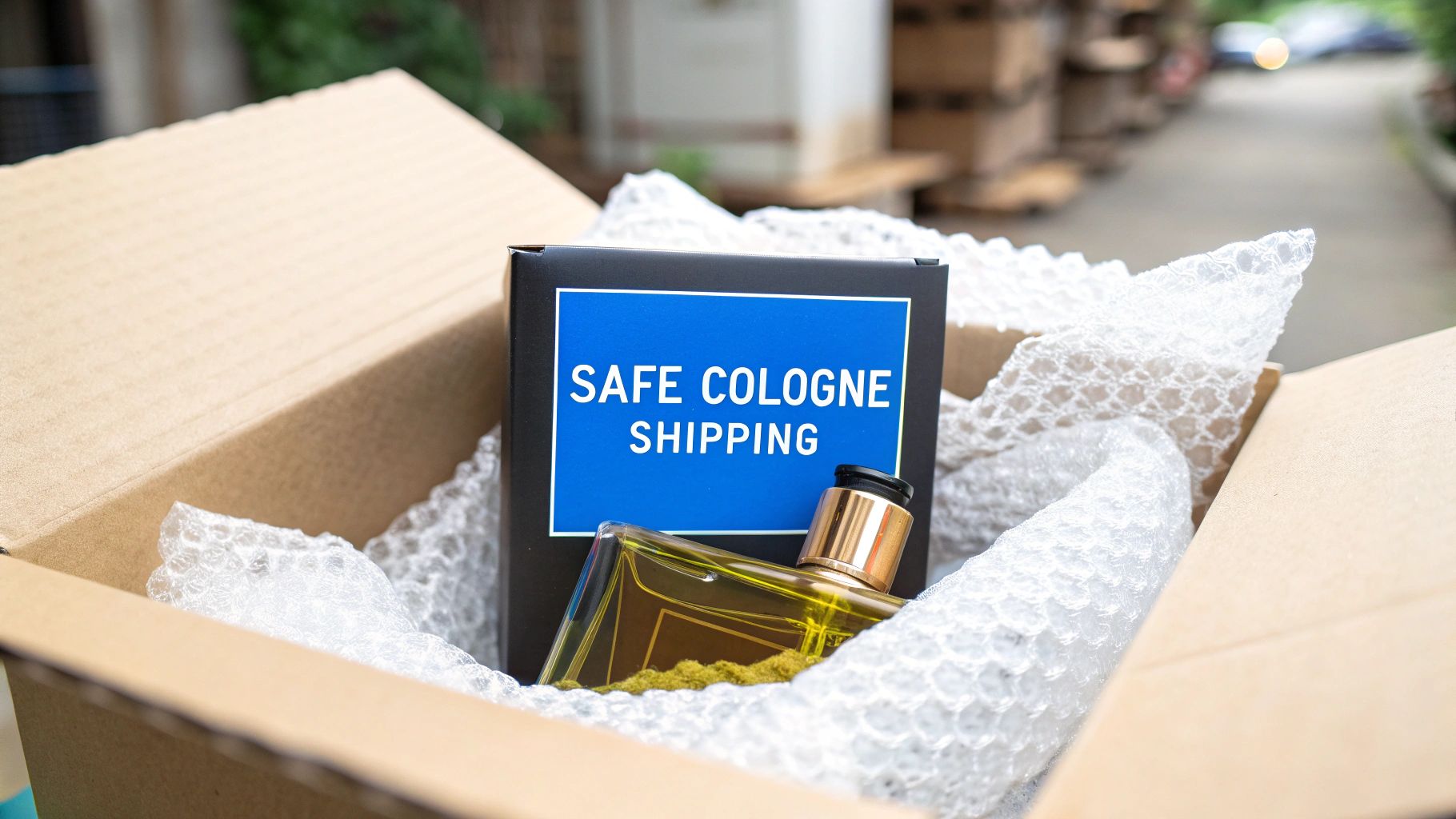
Packaging Cologne to Prevent Leaks and Breakage Getting your classification right is the first hurdle, but your packaging is what truly stands between a happy customer and a box full of shattered glass and disappointment. A broken bottle isn’t just a lost sale—it’s a soured customer experience, a potential safety issue for the carrier, and a direct hit to your profit margins. Honestly, getting the packaging right is the best insurance policy you can have.
The foundation of a secure shipment is a strong, rigid outer box . This is completely non-negotiable. Don't even think about using flimsy mailers or grabbing an old, worn-out box from the back of the warehouse; they've lost their structural integrity and just aren't up to the task. Your box should be just a bit larger than the cushioned cologne bottle, leaving enough room for padding but not so much that the contents can rattle around like a pinball.
Choosing the Right Cushioning Materials With your box selected, the next job is protecting that fragile glass bottle inside. Not all cushioning is created equal, and the best choice really depends on your specific product.
Bubble Wrap: It's a classic for a reason. Tightly wrapping the bottle in a few layers of bubble wrap gives you excellent shock absorption.Foam Inserts: If you're shipping a uniform bottle size, custom foam inserts are the gold standard. They lock the bottle in place, offering unmatched protection.Air Pillows: These are great for filling empty space in the box, but you should always use them with another cushioning material. They’re good for void fill, not for direct impact protection.For total peace of mind, many top brands rely on the box-in-a-box method . It's exactly what it sounds like: you place the cushioned cologne bottle inside a smaller box, then put that smaller box inside the larger shipping box, filling any leftover space with more padding. This double-layer approach is the best practice for shipping anything fragile and valuable. We dive deeper into these pro techniques in our guide on how to pack fragile items for shipping like a pro .
Sealing the Deal to Prevent Leaks A broken bottle is obviously bad, but a leaking one can be just as messy, potentially damaging other packages and causing a major headache with your carrier. Your first line of defense is simple: make sure the cap on your cologne bottle is screwed on as tightly as possible.
But caps can loosen up during the bumps and rattles of transit. That's why you need a secondary layer of protection. After cushioning the bottle, pop it inside a sealed, leak-proof plastic bag . This small step is a lifesaver. It ensures that even if a tiny leak happens, the liquid stays contained and doesn't ruin the entire package. When sourcing your primary packaging, look for durable containers like bottles with advanced inner seals and tamper-evident bands to add yet another layer of security.
Pro Tip: Before you tape up the outer box, give it a gentle shake. If you hear or feel anything moving around inside, you need more cushioning. The goal is a snug, completely immobile environment for your product.
The direct-to-consumer boom has been huge for the fragrance world, but it has also put a spotlight on just how fragile the supply chain can be. While global hubs move billions in fragrance annually, a shocking 22% of DTC beauty orders face damage due to poor handling. With flammable goods like cologne—where temperatures over 30°C can alter 10% of scents —the stakes are even higher.
This flowchart gives you a quick visual guide for navigating those critical first steps.
As you can see, everything starts with the Safety Data Sheet (SDS). You need it to confirm if your product falls under UN1266, which is the key that unlocks your path to using the 'Limited Quantity' shipping exemption.
Understanding Carrier Rules and Labeling Requirements
Once your cologne is perfectly packaged, you've reached the final hurdle: navigating the specific rules of each shipping carrier. This is where a lot of brands stumble. USPS, UPS, and FedEx don't all play by the same rulebook for hazardous materials, and understanding those differences is key to avoiding returned shipments.
Because cologne is a flammable liquid, it is absolutely forbidden from air transport on most standard services. This isn't a suggestion; it's a federal regulation. You must use a ground-based shipping service to keep your shipments safe and legal.
Navigating USPS Regulations The United States Postal Service (USPS) is a go-to for many e-commerce brands, but it also has the most rigid rules for flammable products like cologne. The number one rule to remember? It can only be shipped domestically via ground transport .
Accepted Service: You have to use a surface transportation service like USPS Parcel Select Ground or the newer USPS Ground Advantage .Air Mail Forbidden: Priority Mail and Priority Mail Express are off-limits. These services often involve air travel, which is a non-starter.International Shipping: USPS does not permit individuals or small businesses to ship perfumery products internationally.This makes USPS a solid choice for domestic orders but a dead end for reaching customers overseas. For a deeper dive into these rules, check out our guide on shipping perfume with USPS .
Shipping Cologne with UPS and FedEx Private carriers like UPS and FedEx offer a little more flexibility, but they still demand strict adherence to their hazmat protocols. Both allow you to ship cologne domestically through their ground networks, as long as you follow the Limited Quantity rules.
Both UPS Ground and FedEx Ground/Home Delivery are perfectly suitable options. Unlike USPS, they are equipped to handle international hazmat shipments, but this usually requires a specialized contract and extra certifications that can get complicated for smaller businesses. For most direct-to-consumer brands, sticking to their ground services is the most straightforward path.
Real-World Scenario: Picture this: you get an order for a 100ml bottle of cologne shipping across the country. If you absentmindedly print a Priority Mail label, the package might get rejected at the post office. Worse, it could be caught in transit and sent back to you days later. By choosing USPS Ground Advantage from the start, you ensure compliance and a smooth delivery.
The Critical Art of Labeling Your Package Proper labeling is completely non-negotiable. It's how you signal the contents of your package to every handler in the supply chain, ensuring it gets the right treatment. For Limited Quantity shipments, the labeling is surprisingly simple, but it has to be precise.
The most important label you'll need is the Limited Quantity mark . It's that black-and-white diamond symbol, and it must be at least 100mm x 100mm (about 4x4 inches) unless the package is too small to fit it.
Placement Best Practices Visibility is Key: Stick the mark on at least one side of the box where it's clearly visible and not covered by tape or other labels.Avoid Edges: Don't wrap the diamond mark around a corner. The entire symbol must be on a single flat surface.Add Orientation Arrows: While not always mandatory for small ground shipments, using "This Way Up" arrows is a great practice. It encourages handlers to keep the package upright, reducing the risk of leaks.To help you choose the right domestic carrier, here’s a quick side-by-side look at the essentials.
Carrier Comparison for Shipping Cologne Domestically This table breaks down what you need to know when choosing between the big three for your domestic cologne shipments.
Carrier Accepted Services Air Transport Allowed? Key Labeling Requirement USPS Parcel Select Ground, Ground Advantage No (Domestic Only)Limited Quantity Mark UPS UPS Ground No (Standard Ground)Limited Quantity Mark, Shipping Paperwork FedEx FedEx Ground, FedEx Home Delivery No (Standard Ground)Limited Quantity Mark, Shipping Paperwork
As you can see, the ground service and Limited Quantity mark are the common threads, though private carriers may require additional paperwork.
Don't Forget Marketplace Policies Finally, if you're selling on a platform like Amazon, remember that they layer their own rules on top of carrier regulations. Amazon’s FBA program, for instance, has an extremely strict hazmat review process. You'll need to submit your Safety Data Sheet (SDS) and get formal approval before you can even think about sending inventory to their fulfillment centers.
Failing to comply with both carrier and marketplace rules can lead to rejected inventory, account suspensions, and serious financial losses. The key takeaway is precision—every single package must be packed and labeled perfectly, every single time.
When to Partner with a Specialized 3PL for Fulfillment Trying to master carrier rules, perfect your packaging, and keep up with ever-changing hazmat regulations is a massive undertaking for any growing fragrance brand. You might think handling fulfillment yourself saves money, but it quickly becomes a major bottleneck. That’s time and energy you should be pouring into marketing, creating new scents, and talking to your customers.
There's a tipping point where the sheer complexity of shipping cologne just isn't worth the hassle of doing it yourself. That's the moment to start thinking about a strategic partnership with a specialized third-party logistics (3PL) provider.
This isn’t just about outsourcing packing and shipping. It’s about handing off the entire compliance nightmare to experts who live and breathe these regulations every single day. The right 3PL, one with real hazmat experience, can turn your biggest operational headache into a serious competitive advantage.
Eliminating Compliance Headaches and Reducing Risk A specialized 3PL is so much more than a warehouse—they become your dedicated logistics department. They already have the certifications, training, and infrastructure needed to handle flammable goods like cologne safely and legally.
That means you can stop worrying about:
Training your staff on complex DOT or IATA regulations.Constantly checking for updates to carrier policies.Sourcing all the right materials , from UN-rated boxes to the correct warning labels.A great 3PL takes on the liability. They make sure every single package that leaves their warehouse is perfectly packed, labeled, and documented. This protects your business from hefty fines, rejected shipments, and the ultimate risk—getting blacklisted by a carrier. It's about getting peace of mind.
For Shopify and WooCommerce sellers in the fragrance space, partnering with a 3PL like Simpl Fulfillment is a game-changer. Because of its alcohol content, cologne is classified as a hazardous material, and it demands specialized handling to prevent any leaks or spills in transit. Poor packaging is a huge issue in the beauty industry, leading to return rates as high as 15-20% .
But with the right protocols—like using UN-certified boxes and storing products in temperature-controlled warehouses—damage claims can plummet to below 1% . Simpl’s expertise in hazmat fulfillment ensures every shipment is compliant. They even use 3D scanning to find the perfect box size, which can cut shipping costs by up to 30% while slashing waste. The fragrance market is booming, and keeping up requires operational excellence you can read more about here .
Unlocking Efficiency and Better Shipping Rates Compliance aside, one of the biggest wins of partnering with a 3PL is tapping into their negotiated shipping rates. 3PLs ship staggering volumes for hundreds of clients, giving them the leverage to secure deep discounts from carriers like UPS , FedEx , and USPS —discounts a single small business could never get on its own.
These savings get passed directly to you. In many cases, the money you save on shipping can offset the 3PL's service fees, ultimately lowering your total cost per order.
On top of that, a professional fulfillment center operates with machine-like efficiency. Their entire workflow is built for speed and accuracy, making sure orders are picked, packed, and shipped out the same day they come in. This kind of speed is a huge driver of customer satisfaction and loyalty. Suddenly, shipping is no longer just a necessity; it becomes a key part of your premium brand experience, letting you focus on growth while the experts handle the tricky logistics of how to ship cologne.
Common Questions About Shipping Cologne You've got the basics down, but shipping cologne always seems to have a few tricky "what if" scenarios. It's totally normal to have questions—the rules can be confusing, and nobody wants to get this stuff wrong.
Think of this section as your quick-reference FAQ. I’ve rounded up the most common questions we hear from fragrance brands to give you clear, straight-to-the-point answers.
Can I Ship Cologne Internationally? This is the big one, and the short answer is: it's complicated. While it’s technically possible, shipping cologne across borders is a whole different ball game compared to shipping within the US.
For starters, just forget about using USPS for international perfume shipments. They flat-out prohibit it for individuals and small businesses. That door is closed.
So what about private carriers like UPS or FedEx ? They can handle these kinds of shipments, but it’s not a service you can just sign up for. You’d need to:
Secure a special hazmat contract with them. Get yourself and your team through extensive, IATA-compliant training and certification. Prepare a mountain of paperwork, including detailed customs forms and specific shipper's declarations for dangerous goods. Honestly, for most growing brands, the cost and headache just aren't worth it. The smartest move is to nail down your domestic ground shipping process first. Master that, and then you can think about taking on the world of international fragrance logistics.
Do I Need Special Training to Ship Cologne? Yes and no. This is where the Limited Quantity exemption is your best friend. If you are only shipping cologne via ground within the US under this rule, you don't need the same intense hazmat certification required for air freight or bulk shipments. The entire point of the Limited Quantity provision is to make it simpler for sellers like you.
But—and this is a big but—the Department of Transportation (DOT) still holds you responsible for knowing the rules. You and your team absolutely must understand:
How to read a Safety Data Sheet (SDS) to classify your product. The exact packaging requirements to prevent any leaks or breaks. How to correctly apply the Limited Quantity diamond mark to your box. Key Takeaway: You might not need a formal DOT certificate hanging on your wall, but you are legally required to have the knowledge. "I didn't know" won't fly if a package is damaged or inspected. It’s less about "required certification" and more about "required competence."
What Is the Biggest Mistake to Avoid? If there's one mistake that trips up new sellers more than any other, it's choosing the wrong shipping service . Specifically, trying to ship cologne via air.
It's an easy error to make. You’re used to using services like USPS Priority Mail because it's fast and reliable. The problem is that Priority Mail often travels by airplane, and that’s a huge no-go for flammable liquids like cologne unless you have full hazmat credentials.
Trying to sneak a bottle of perfume onto a plane is the fastest way to get your shipment flagged, returned, or even seized. It tells carriers you don't know what you're doing and could get your shipping account scrutinized. Always, always stick to a ground-only service like USPS Ground Advantage , UPS Ground , or FedEx Ground .
Can I Use the Free Boxes from the Post Office? Absolutely not. Do not use the free Priority Mail or Priority Mail Express boxes from USPS. This is directly tied to the "biggest mistake" we just talked about. Those boxes are made exclusively for air-based services.
Using Priority Mail packaging for a ground shipment is a direct violation of USPS policy. Not only could they refuse the package, but as of late 2025, they may start charging a penalty fee, which would get billed back to you or taken from your marketplace funds.
Stick to these two simple options for packaging:
Use your own plain brown or white boxes. This is the easiest and most common approach.Order free USPS Ground Advantage supplies. Some marketplace sellers, like those on Poshmark , have special access to order complimentary Ground Advantage boxes and mailers. This program was created specifically to help sellers make this transition correctly.Just remember this simple rule: your box must match your shipping label. It’s a small detail that saves you from major headaches.
Trying to keep up with hazmat rules, carrier policies, and packaging protocols can feel like a full-time job, pulling you away from building your brand. Simpl Fulfillment handles the complexities of cologne fulfillment for you. We provide compliant warehousing, expert packing, and access to discounted ground shipping rates, turning a logistical nightmare into a smooth operation.
Ready to stop worrying about shipping rules and get back to growth? See how Simpl Fulfillment can help .